|

Dr. Ana Pajtler Rošar, MD
EYE DIAGNOSTICS
Clarity in vision, warmth in care
I care deeply about eye health and am committed to helping each person maintain or improve their vision. My work focuses primarily on retinal conditions, including age-related macular degeneration, high myopia, diabetic eye disease, intraocular inflammation, and retinal vascular disorders. I use modern, evidence-based diagnostic and treatment methods, such as advanced imaging, intravitreal injections, and laser therapy. In my practice, I strive to create a space where you feel at ease, listened to, and truly understood. I believe the best outcomes are achieved together — through trust, collaboration, and genuine care for your vision.
Watch a short video of how an eye examination works

Book an appointment
Ana Pajtler Rošar Eye Clinic
Monday to Friday, 9:00–19:00
Saturday, 9:00–12:00 (by phone)
You can also fill out the form and we will contact you as soon as possible.
*The company pays special attention and care to the protection of your personal data. Detailed rules regarding the use and processing of your personal data can be read in the Privacy Policy.

Practice
is located within Optika Mali

Address
Cankarjeva cesta 7, 1000 Ljubljana

Phone / E-mail
051 477 436
ambulanta@medvista.si

Practice hours
Monday - Friday by agreement
Eye Examinations
VISION EXAMINATION AND GLASSES OR CONTACT LENS PRESCRIPTION
This examination is intended for anyone who:
- has difficulty seeing at a distance or up close
- needs new glasses or an updated prescription
- is considering wearing contact lenses.
It includes precise vision and refraction measurements, corneal shape assessment, and a basic eye health examination. Based on the results, we recommend the most appropriate vision correction and prescribe glasses or contact lenses if needed. For contact lens fittings, we also provide guidance on proper use and care, and you will receive your first pair.
COMPREHENSIVE EYE EXAMINATION
This examination is intended for anyone experiencing vision problems not caused solely by refractive error, for example:
- decreased or blurred vision, or image distortion
- visual disturbances and/or flashes of light
- gritty, burning, stinging, dry, or inflamed eye sensation
- suspected cataract or follow-up after cataract surgery (e.g. posterior capsule opacification requiring YAG laser capsulotomy)
- people with diabetes seeking a preventive eye examination
- anyone requiring a thorough assessment of eye health
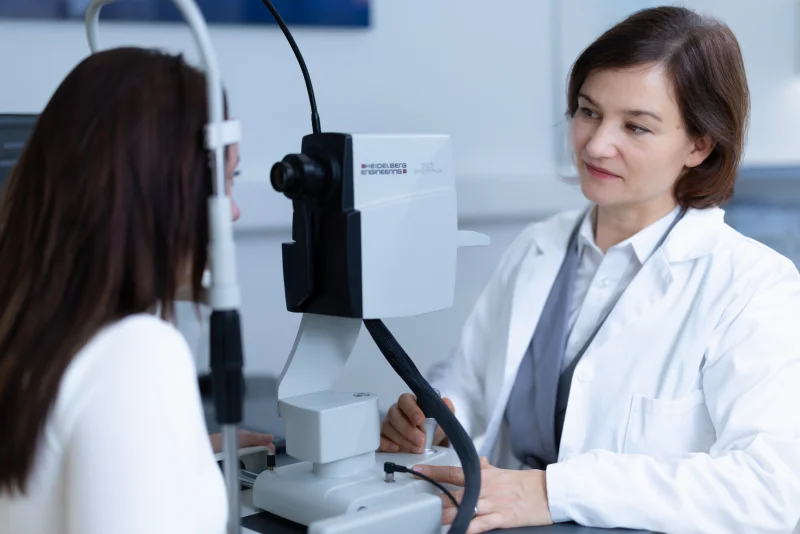
In addition to vision and refraction measurements, the examination includes a detailed evaluation of the anterior and posterior segments of the eye, as well as retinal imaging using optical coherence tomography (OCT) with the Spectralis Heidelberg device. OCT is a non-invasive, laser-based imaging method that enables early detection of microstructural changes in the retina.
For patients with diabetes and no signs of complications, this examination is an appropriate preventive measure, allowing early detection of initial changes and helping to prevent diabetic eye disease.
MEDICAL RETINAL ASSESSMENT
This examination is intended for:
- patients with known or suspected retinal diseases, such as age-related macular degeneration, high myopia–related changes, diabetic retinopathy, or other retinal conditions
- patients with diabetes who already show signs of diabetic retinopathy
- anyone requiring precise monitoring or treatment of retinal conditions, including:
- retinal laser treatment
- corticosteroid injections (e.g. Ozurdex implant)
- intravitreal anti-VEGF injections (e.g. Eylea, Vabysmo, Lucentis)
It includes a comprehensive eye examination and non-invasive multimodal retinal imaging using the Spectralis device, combining multimodal imaging (OCT, OCT angiography, and fundus autofluorescence). You will also receive:
You will also receive:
- a clear explanation of your condition
- advice on preventive measures to protect your vision
- recommendations for appropriate eye health supplements
This examination is essential for preserving vision in patients with macular degeneration, retinal diseases, and diabetic eye complications.
GLAUCOMA ASSESSMENT
This examination is intended for:
- individuals diagnosed with glaucoma
- those with suspected glaucoma
- individuals with elevated intraocular pressure or a family history of glaucoma
- patients who may require laser treatment – selective laser trabeculoplasty (SLT)
It includes a comprehensive eye exam, intraocular pressure measurement, gonioscopy, and specialized OCT imaging of the optic nerve and macula using the Spectralis device. Glaucoma often progresses without pain or early warning signs, but can lead to permanent vision loss if left untreated. Regular and accurate eye examinations are therefore essential for early detection, appropriate treatment (eye drops or laser therapy), and long-term preservation of vision.
EYE EXAMINATION FOR DRIVING LICENSE
This examination is intended for anyone who needs:
- a medical assessment for obtaining or renewing a driver's license (categories B, C, or E)
- an official ophthalmological report for occupational health purposes
During the examination, we assess whether your visual function meets the legal requirements for safe driving. This includes precise measurement of visual acuity, and, if needed, testing of color vision and visual fields.
After the examination, you will receive an official report to submit to your occupational health physician as part of the licensing process. The examination is suitable for both younger candidates and older drivers who require regular vision monitoring, especially in the presence of conditions such as cataracts, glaucoma, or diabetic eye disease.
If necessary, dilating eye drops may be used during the examination. Their effect begins within 15–30 minutes and can last up to 4 hours. Driving is not recommended during this time, so please arrange alternative transportation if possible. Please allow up to 60 minutes for the examination.
Diseases and Treatment
Age-Related Macular Degeneration (AMD)
Age-related macular degeneration is a chronic retinal disease that becomes more common after the age of 50. It affects the macula, the part of the retina responsible for sharp central vision—essential for reading, recognizing faces, and noticing fine details. AMD progresses slowly and is often initially asymptomatic, making early detection possible only through preventive eye examinations.
There are two main types:
- Dry AMD progresses gradually due to degeneration of macular cells.
- Wet AMD is less common but more severe, as abnormal blood vessels damage the macula and cause rapid vision loss.
Treatment:
- Dry AMD: regular monitoring, self-checks with the Amsler grid, maintaining a healthy lifestyle, nutritional supplements (AREDS2), and newer light therapy options such as photobiomodulation (PBM).
- Wet AMD: intravitreal anti-VEGF injections and regular follow-up examinations.
Early intervention can make a crucial difference in preserving vision.
High Myopia
High myopia (−6 diopters or more) increases the risk of complications because the eye is longer and the retina is thinner. Potential risks include retinal tears or detachment, macular degeneration, pathological blood vessels, glaucoma, and cataracts. These changes are often painless and may go unnoticed.
Treatment:
- Regular check-ups
- Laser treatment for dangerous retinal changes, such as tears
- Intravitreal drug injections for pathological blood vessels or macular swelling
Diabetic Retinopathy
Diabetes can damage the small blood vessels in the retina, leading to diabetic retinopathy. The condition is often initially asymptomatic but can result in severe vision loss if untreated. Regular preventive examinations are essential for early detection.
Treatment:
- Good control of blood sugar, blood pressure, and lipid levels
- Anti-VEGF injections or corticosteroid implants (Ozurdex) for macular swelling
- Laser treatment for abnormal retinal vessels
- Surgery in selected cases
Glaucoma
Glaucoma is a chronic eye disease in which the optic nerve gradually deteriorates. It often progresses without symptoms at first, and any vision loss is irreversible. The condition is most commonly associated with elevated intraocular pressure.
Treatment:
- Eye drops to reduce intraocular pressure
- Selective laser trabeculoplasty (SLT)
- Surgery if necessary
The main goal of treatment is to slow or stop the progression of the disease.
Cataract
Cataract is the gradual clouding of the eye's natural lens, most commonly related to aging. It can cause blurry vision, reduced contrast, glare, and difficulty seeing at night.
Treatment:
- Surgery to remove the cloudy lens and replace it with an artificial intraocular lens
- YAG laser capsulotomy later if the lens capsule becomes cloudy
Dry Eye
Dry eye is a common chronic condition in which the tear film does not adequately protect the eye's surface. Symptoms include burning, redness, eye fatigue, and occasionally blurred vision.
Treatment:
- Artificial tears or gels
- Eyelid hygiene and warm compresses
- Anti-inflammatory eye drops if needed
- Adjustments to work habits and environment
About Me
Dr. Ana Pajtler Rošar, MD
Specialist in Ophthalmology - Subspecialist in Retinal Diseases with over 20 Years of Clinical Experience in Slovenia and Abroad
I graduated from the Faculty of Medicine in Ljubljana in 2005 and have since dedicated my professional career to ophthalmology, focusing on modern approaches to the diagnosis and treatment of retinal diseases. I completed my ophthalmology specialization at the Eye Department of the General Hospital Celje and at the Eye Clinic in Ljubljana. In 2010, I successfully passed the European Board of Ophthalmology specialist exam in Paris and earned the title FEBO (Fellow of the European Board of Ophthalmology), representing the highest European standard of professional excellence.
Between 2017 and 2018, I was part of the international academic and clinical environment at the University of Milan, Luigi Sacco Hospital. Under the mentorship of Prof. Giovanni Staurenghi, I further subspecialized in retinal disease diagnosis and treatment, actively participating in research projects. There, I deepened my expertise in advanced multimodal imaging techniques, including autofluorescence, optical coherence tomography (OCT), and OCT-angiography (OCT-A)—today the foundation of precise retinal diagnosis.
In 2022, I earned my PhD at the Faculty of Medicine in Ljubljana under the mentorship of Prof. Nataša Vidović Valentinčič and Prof. Giovanni Staurenghi. Between 2007 and 2023, I was employed at the Eye Clinic in Ljubljana, where I performed cataract surgeries and was deeply involved in the management of patients with retinal diseases.
I actively participate in professional associations in Slovenia and Europe and am a member of the European Association for Retinal Diseases (EURETINA).
I am a member of the Medical Chamber of Slovenia, the Association of Ophthalmologists of Slovenia (ZOS), the Slovenian Medical Association (SDZ), and the Medical Chamber of Surgeons and Dentists of the Province of Milan (OMCeO Milano) in Italy.
My professional interests focus on diagnostic imaging and treatment of retinal diseases, including age-related macular degeneration, diabetic eye complications, high myopia, retinal vascular diseases, and intraocular inflammation. I utilize advanced treatment methods such as laser therapy and intravitreal injections of biological drugs (anti-VEGF).
In my practice, I strive to provide the highest level of professional care, supported by advanced diagnostic methods and personalized treatment plans.